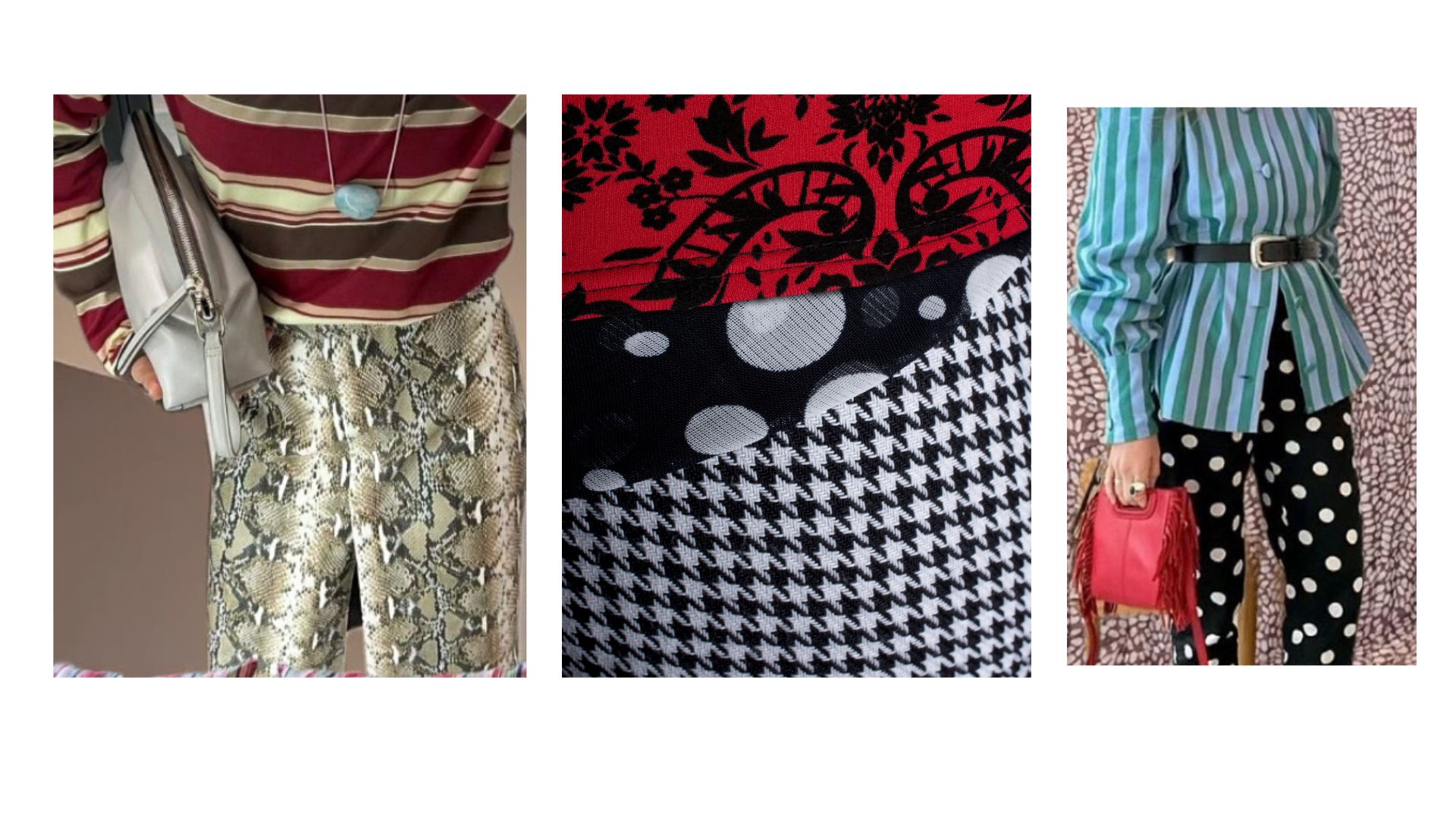
How To Mix Patterns with Confidence for Beginners
How to Mix Patterns With Confidence (Even If It Scares the Life Out of You)
Okay, so let’s talk about pattern mixing.
Something I hear a lot from women is:
“Oooo, I love pattern mixing when I see it on other people…”
But when I ask,
“So, do you want to give it a try?” More often than not, there’s a hesitation and a “Nooo, that’s not for me… I’m not [stylish/bold/confident] enough.”
So often, without even trying, they’ve already decided it’s not for them. Usually, because deep down, there’s a quiet fear that they’ll get it wrong and end up looking a bit ridiculous.
And I get it.
Especially if you’re new to it, pattern mixing can feel risky. It seems like the kind of styling move reserved for women with fashion degrees, or the stylists pulling looks for the cover of Vogue.
But here’s the thing.
Even though pattern mixing can look like it’s been thrown together in a flurry of fabulous chaos, when it works, it’s because it’s been put together with intention. There’s actually a method behind the madness.
So if you’ve ever tried it and it didn’t work, here’s the truth: it’s not because you can’t do it. It’s not because you’re not “enough” to pull it off. It's because you didn't know the method!
So I’m going to gently encourage you to give it another go.
Because once you understand how to build a pattern mix with purpose, and you’ve got a bit of structure behind it, it gets easier. And honestly, a lot more fun!
You don’t need to be a fashion editor or a stylist. You just need to know what you’re looking for!
So grab a coffee, and let’s get into the three simple steps that’ll help you mix prints like a pro, no fashion degree required!
Why Pattern Mixing Can Feel So Tricky

There’s a funny thing we do, especially when it comes to style, where we expect to be good at something without ever practising it.
So if you’ve tried pattern mixing in the past and didn’t love the result, maybe it looked chaotic or just felt a bit off, it’s not because you’re not stylish enough, bold enough, or capable enough to carry it off.
You absolutely are.
It’s usually more about practice and strategy than anything else.
You wouldn’t expect to speak French without learning and practising, would you?
So if no one’s ever shown you how to mix patterns like an absolute goddess, then why on earth would you know how to do it? Just like style in general, pattern mixing is a skill, one you can learn.
And then there’s the confidence gap.
The confidence to wear the bolder thing comes from simply doing it. Repeatedly. Until it doesn’t feel scary anymore.
BUT
If you’re not used to wearing something that feels a bit more individual or attention-grabbing, it often makes the most sense to take a stepping-stone approach. You build up to where you want to be. Bit by bit vs jumping in with both feet.
Anyhoo, the purpose of this blog is to take the guesswork out of it and give you a bit of structure (not rules, promise).
But first, here are a few common things that tend to trip people up when they start mixing patterns, and it’s not quite landing how they want:
Pairing two patterns that are too similar in size:
Like teeny-tiny florals next to teeny-tiny polka dots. There’s not enough contrast, so your eye doesn’t know where to focus — and the whole outfit can feel a bit messy, even if the pieces are lovely on their own.
No colour thread to connect the pieces
Pattern mixing works best when there’s a visual through-line. A shared colour, even just a hint, creates cohesion and makes it feel intentional, not random.
Hovering or half-committing vs going all in.
We’ll come back to that shortly, because spoiler: sometimes more is better.
The 3-Step Pattern Play Framework
Let’s be clear, this isn’t a “right way or wrong way” situation.
There’s no one way to mix patterns, no sacred rules carved into a fashion stone tablet. It’s about finding what feels good for you, and understanding the little things that make a mixed-print outfit work — so you’re not just throwing things together and hoping for the best.
This is the method I’ve found works really well for me (and for the women I style). It takes out the guesswork and gives you a bit of structure, so you can get playful and feel confident doing it.
Step 1: Pick Your Anchor Pattern

Start by choosing your first print. This is what we’ll call your anchor pattern — the one you’re building the rest of the outfit around.
It might be:
a bold tartan
a delicate or massive floral
a favourite striped top
a leopard print that’s been hanging around waiting for a moment
Whatever it is, this becomes your starting point — and we’ll use it to help make decisions about what comes next.
Step 2: Pick Your Colour Thread

Next, pick out a colour from your anchor pattern that you can echo somewhere else in your outfit.
This doesn’t need to be a big splash — it can be:
a tiny pop of blue in a stripe
a blush tone in a floral
a sliver of tan in an animal print
It doesn’t have to be an exact match. Just similar enough to create that sense of connection.
That colour becomes your thread — the visual link that pulls the whole thing together.
When you get this right, it’s the moment your brain quietly goes, “Ah, yes, that works.”
Step 3: Choose Your Second Print

(Using the Colour Thread + Contrast in Scale)
Now it’s time to bring in your second pattern — and this is where the colour thread and a contrast in scale come together.
Sometimes these happen at the same time. You’ll spot a bit of green in your anchor pattern and realise your polka dot skirt has green too.
Or you’ll notice your stripey jumper is quite bold, so you balance it with a smaller-scale floral. Or you think ooo I can add a belt here which will nod to that down there!
When choosing your second print, make sure it:
Echoes the colour thread from your anchor pattern
Contrasts in scale — big with small, bold with subtle, chunky with delicate
That balance is what gives your outfit harmony and stops the prints from competing.
The Eye-Flow Check (Your Final Test)
Before you leave the house, do one final check.
Ask yourself:
Does my eye move around the outfit easily, or does it get stuck somewhere?
If it flows — you’re good to go.
If something feels “off”, it’s usually one of these:
The prints are too similar in scale
There’s no colour thread tying them together
You’re hovering — not quite committing to the look
Often, the biggest difference is leaning more into the look, not less!
Let’s Talk About Not Quite Committing (And Why Full Commitment Can Be the Magic)
Pattern mixing can feel like a lot, I get it.
If you’re not used to it, throwing on three clashing prints might feel like dressing up for a theatre show you didn’t audition for. So it makes total sense to start small.
One of my clients started with a tiny striped sock and a leopard print scarf. That was her version of pattern mixing, and it was a brilliant stepping stone from her usual all black. It gave her a way in without feeling overwhelmed.
But here’s what she said later:
"I mean technically pattern mixing and it's ok… but it doesn’t give me the FYEAH feels like I get when I see it on other people."
Sometimes, when we dip a toe in just a whisper of a mix, nothing too bold, it doesn’t quite land.
Not because you’ve done it wrong, but because you’re holding back.
And with pattern mixing, especially, the real joy comes when you just go for it.
It’s one of those things that often works best when you fully commit vs trying to just sneak instead!
That’s when the energy clicks. That’s when the outfit feels like a fuck yeah!
And honestly, IMO this applies across the board when it comes to personal style. I see women holding back all the time!
Examples, please, Sarah! Of course...
You like the oversized look, so you buy the oversized trousers, but pair them with your usual slim-fit top because fully oversized feels “too much”
You wear a bold colour… but only as a sock or nail polish, not because you don't want to go head to toe, but because the full dress feels scary!
And again, starting small is fine. There’s nothing wrong with taking it one step at a time.
But just know: sometimes, the reason something isn’t quite working is that you’re hovering.
You’re doing the idea… but not quite owning it.
So if your outfit feels a bit off, try asking yourself:
What would this look like if I leaned in just a little more?
That’s usually where the magic lives and often confidence makes styling decisions land, not the other way round!
Real-Life Examples
Let’s break down what this actually looks like in real life. Because this isn’t about theory — it’s about outfits that work when you walk out the door.
Here’s one I’ve worn and loved for you to use as a springboard.

Example 1: Tartan Skirt + Polka Dot+ Sports Jersey
Anchor Pattern: Tartan skirt
Colour Thread: Blue in the jersey echoed the blue thread in the tartan
Scale Contrast: Large tartan + small polka dots
Eye Flow: nothing felt random, everything looked intentional

Example 2 :Camo Trousers + Leopard blouse + Pink sweatshirt
Anchor Pattern: Camo Trousers
Colour Thread: Leopard + Camo = Neutral base. Pink at the top, middle and bottom.
Scale Contrast: Larger camo + smaller leopard + solid colour

Example 3: Stripes + stripe + polkadots
Anchor Pattern: Stripe trousers
Colour Thread: Red and blue. The red is obvious! The navy is in the bow at my neck
Scale Contrast: Small stripes + slightly wider stripes + very wide stripes + small to mid polka dots
Other pattern mixes I've worn!

Quick Pattern Mixing Q&A
These are common Qs I hear all the time:
Can I still wear a solid colour with pattern mixing?
Absolutely, as you can see from my examples, I do this a lot. Adding a solid piece can help ground the outfit and give the eye a bit of a breather.
Is there a colour formula or ratio I should follow?
I don’t work in numbers; I go by feel.
But if you’re someone who likes a bit of structure, the 60-30-10 rule can help. That’s 60% main colour, 30% secondary, 10% pop. It’s more of a guide than a rule, but it can give you a useful starting point. But also IMO don't get too stuck on it, and you absolutely can go more than 3 colours!
Can I mix more than two patterns?
Yes, but it might be a plan to start with two.
Once you’ve nailed the colour thread and contrast, adding a third becomes easier; just make sure each new pattern follows the same logic.
Can I pattern mix with accessories?
Absolutely. Scarves, shoes, bags, even tights, accessories are a great way to dip your toe in, or add an extra pattern once you’re confident.
Before We Wrap, A Quick Side Note on Patterns

There are a couple of prints that, in my book, you can treat just like neutrals.
Leopard and camo are two of them.
They don’t shout for attention the way some other prints do, and they pair beautifully with a whole range of other patterns.
So if you’re feeling nervous about diving into pattern mixing, starting with one of these in the mix is a great way to ease in!
Final Encouragement For Your Pattern Mixing Adventures
Let’s wrap this up with a gentle reminder:
You don’t have to get it right the first time.
This is play, not pressure!
When you understand how to mix patterns with intention, using colour, scale, and flow, the whole thing becomes less intimidating and a lot more fun!
So go play. See what happens when you lean in. Try a new combo, even just for nipping to the supermarket for milk or WFH! I bet you any money you'll be surprised yourself at how you make it work!
And if you feel you need a bit more help, feel free to DM me on Instagram with your questions or fill out this form here.
PS, in case you didn't know, I'm a style coach, which is the perfect blend of personal styling and life coaching to make you be the best version of yourself inside and out! You can find out more about how to work with me here.